CASE STUDY
CHECK IT

Pasuyo App (iOS & Android)
Role:
Solo Founder and Solo Full-stack Software Developer and Designer
Tech Stack:
Expo, React Native, TypeScript, NativeWind, Axios, Ruby on Rails (deployed on Render), Devise, JWT, PostgreSQL (hosted on Render), REST API (deployed on Render), Action Cable (WebSocket for real-time chat), ActionMailer (for automated emails and notifications), Redis (hosted on Upstash), Rack::Attack, Cloudflare R2 (for photo storage), Git, GitHub
Project Overview & Goal:
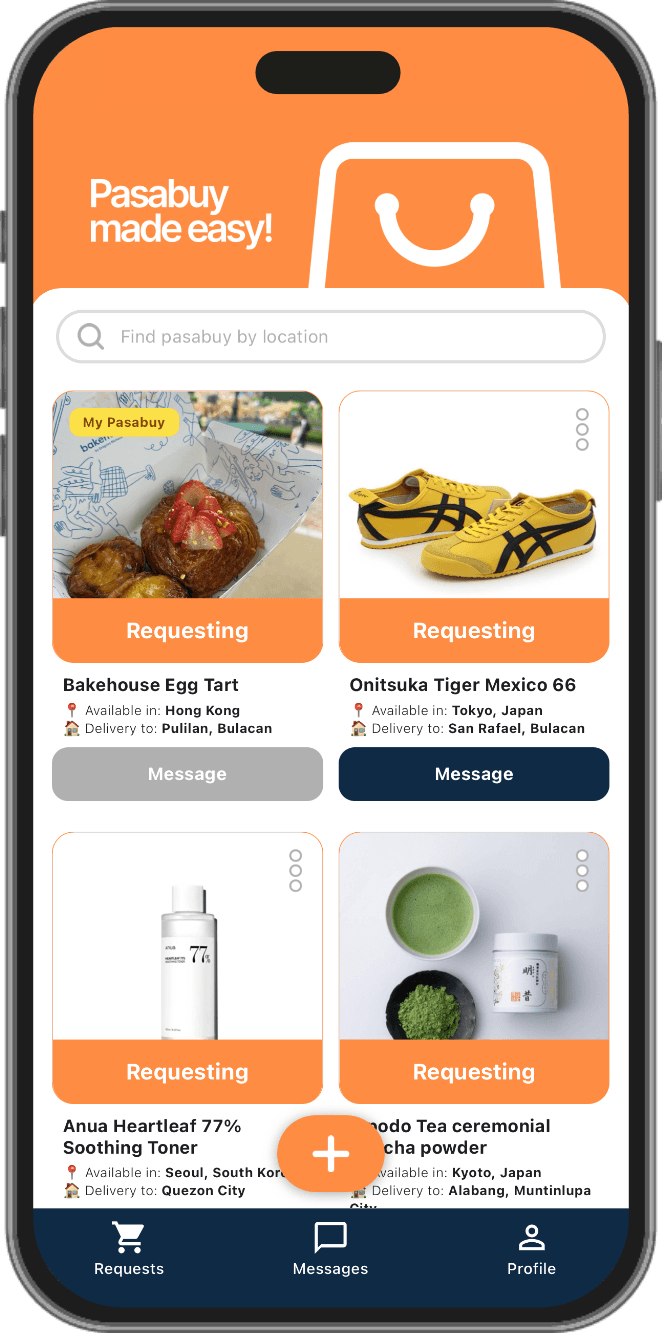
Pasuyo is a lean MVP app designed to let travelers earn a sideline by turning their extra baggage space into opportunity. Travelers can browse and fulfill pasabuy requests without relying on cluttered platforms like Facebook. The goal is to streamline cross-border errands, making the process simple and trustworthy for both requesters and travelers.
Development Process:
I developed Pasuyo V1 using Expo React Native for cross-platform mobile deployment and NativeWind for responsive UI design. The app includes separate flows for requesters and travelers, allowing posting, browsing, messaging, and review submissions. User authentication is implemented via email login. The backend uses Ruby on Rails to handle authentication, user management, request posting, status tracking, and real-time internal chat messaging with push notifications. It also includes a moderation system with reporting, blocking, and suspension, ensuring user safety and compliance with Apple App Store guidelines. The backend APIs and PostgreSQL database are deployed on Render, Redis is hosted on Upstash, and photo storage is handled via Cloudflare R2, providing a reliable and scalable production environment.
Challenges:
I faced many challenges, but the main challenges stemmed from building many features for the first time, like real-time messaging with push notifications and using storage solutions like Cloudflare R2. Much of the difficulty came from managing many moving parts, handling numerous edge cases, and navigating incomplete or outdated documentation and tutorials. I also had to go back and forth between the frontend, backend, and database as a solo developer. Additionally, designing a clean UX for both requesters and travelers within a lean V1 scope, and ensuring reliable request status updates across devices, required careful iteration and a balance between simplicity and completeness.
Solution:
For this app, although my fundamentals in React and Ruby on Rails were already strong, the main challenges came from implementing features for the first time, as I described in the Challenges section. To solve them, I primarily relied on documentation, online examples, and other internet resources. However, since many of these sources were outdated, I strongly relied on my product thinking and technical fundamentals to guide how I used AI assistance (the free version of ChatGPT) not only for step-by-step guidance but also for brainstorming solutions and approaches. I did not blindly copy and paste suggestions; instead, I studied and tested each step carefully, eliminating code that didn’t make sense. Additionally, I implemented safeguards such as database indexing, model validations, frontend checks, and API rate limiting to ensure reliability, security, and stability. Through this trial-and-error process, I was able to find effective solutions to the challenges I faced. I focused on building only the essential core features that fulfilled the goal of this V1.
Outcome:
Pasuyo App provides a functional platform for travelers to earn from extra baggage space and for requesters to conveniently request items without relying on cluttered social media channels. The app is fully built, laying the foundation for future feature expansion, and is currently in its pre-launch and marketing phase as it prepares for initial user adoption and real-world validation.
Contributions:
Designed, developed, and published the entire V1 mobile app and backend as a solo developer.
Learnings:
This project strengthened my expertise in Expo React Native, TypeScript, NativeWind, and Ruby on Rails, while also deepening my experience building MVPs under real-world constraints. I learned to implement complex features for the first time, such as real-time messaging with push notifications, and how to handle storage solutions like Cloudflare R2 and others. I developed stronger problem-solving skills through trial-and-error, AI-assisted research and brainstorming, and careful evaluation of outdated documentation. I also gained practical experience implementing safeguards like database indexing, model validations, frontend checks, and API rate limiting. Overall, this project enhanced both my technical skills and product thinking, especially in managing first-time challenges across the frontend, backend, and database as a solo developer.
Completed:
March 2026